Seoul closes Jamsu Bridge to cars every Sunday — the free “Walk-Walk” festival ending June 14
Jamsu Bridge closes to cars for good from October 26 — October 25 is the last car-free festival (October 20 update)
Seoul has announced that Jamsu Bridge closes to all cars from midnight on October 26, 2026, while it is rebuilt as a pedestrian-only bridge. Work is due to finish by August 2027, and cars will not return. Sunday, October 25 (2–10 PM) is the last car-free Ddoo-beok festival on the bridge, with a "Jamsu Bridge Chicken Day" as its special program. During the works you can still walk or cycle across, except during paving from May to August 2027, when the bridge closes to everyone. Buses 740 and 405 now cross Banpo Bridge instead, and the two "Banpo Hangang Park · Sebitseom" stops close; use "Banpo Bridge South · Hangang Park Entrance" instead.
On Sunday mornings this spring, Seoul does something most cities cannot: it shuts down a major bridge over the Han River and turns it into a pedestrian-only road for the day. The bridge is Jamsu Bridge — the lower deck of the iconic Banpo Bridge — and the event is the Car-Free Jamsu Bridge "Ddoo-beok Ddoo-beok" Festival ("ddoo-beok" being the Korean onomatopoeia for "footstep, footstep"). It is free, runs every Sunday from late April to mid-June, and is one of Seoul's most underrated visitor experiences.
The window — three Sundays left in spring
- Spring run: April 26 → June 14, 2026 (every Sunday, 8 weeks)
- Fall run: September 6 → October 25, 2026 (every Sunday, 2–10 PM). October 25 is the last car-free festival before the bridge closes to cars for good on October 26.
- Traffic control hours: Sunday 11:00 AM → 11:00 PM
- Remaining Sundays in spring: May 31, June 7, June 14 — then a summer break before fall
- Cost: Free admission to the bridge and parks. Some hands-on programs charge fees.
What you can actually do
Programming repeats most Sundays with weekly variations. Typical hours:
- Morning Run (Ddoo-beok Morning): 7:00–9:00 AM. A 2 km route from Banpo Moonlight Plaza to the north end of Jamsu Bridge. Casual, all-ages.
- Marching-band parade: 4:00 PM and 7:00 PM. Marching bands + giant balloon characters crossing the bridge.
- Riverside performances: Throughout the afternoon. Indie singers, busker stages, "Nook-by-Nook Live" (구석구석라이브) pop-up performances.
- Food trucks: 30 trucks lined along the bridge and Banpo Hangang Park.
- Moonlight Night Market (달빛상점): Local artisan and craft stalls; evening light setup.
- Seoro Market (서로장터): Community-run small market.
- Yoga / outdoor fitness: Weekly sessions with English-friendly instructors (some sessions led by Indian yoga instructors).
Specific dates have rotating special programs — for example, mid-May featured a "Spring Sports Day" and a guitar flash mob. Check the festival's Instagram closer to the date for the exact weekly highlight.
Why it's worth a Sunday slot
Three reasons casual travelers under-rate this:
- The bridge view is rare: You normally cannot walk on the lower deck of Banpo Bridge — cars own it, at least until October 25. From October 26 the bridge closes to cars for good and is rebuilt as a pedestrian-only bridge. On a closed Sunday, you walk down the middle of the road with the Han River on both sides.
- It's actually free: Most big Korean festivals charge admission. This one charges only for hands-on experiences (yoga gear rental, food truck purchases).
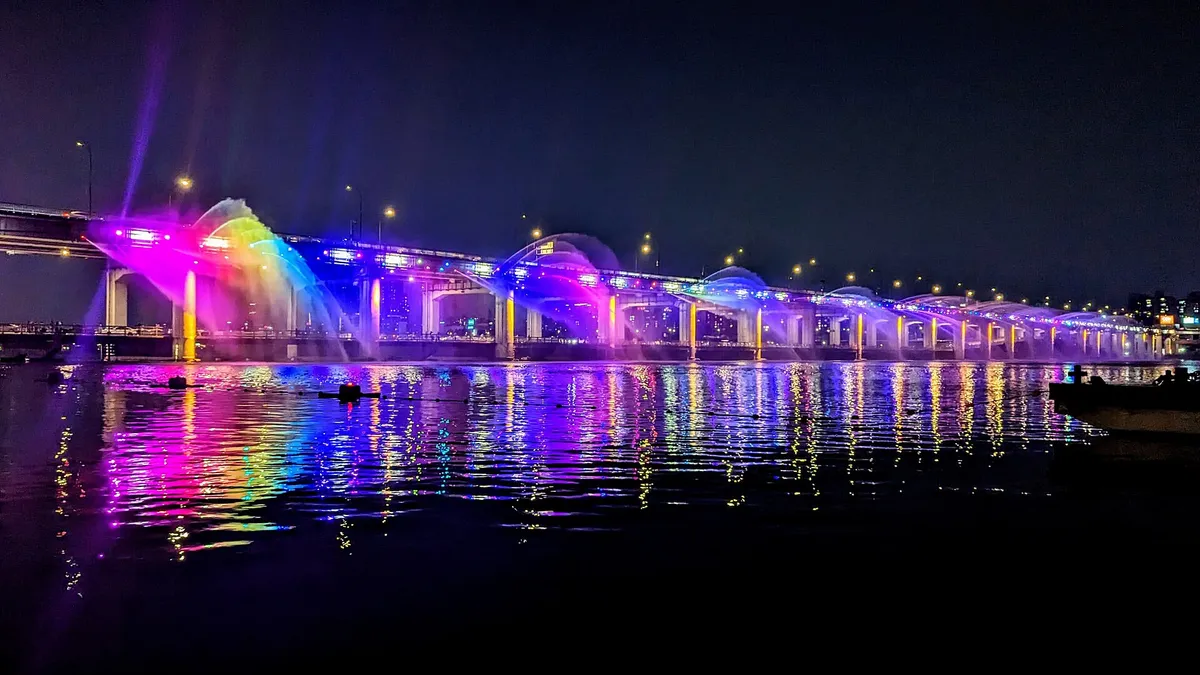
- You can stack it with the Moonlight Rainbow Fountain: The Banpo Bridge Rainbow Fountain runs in the evening — 8 PM and 9 PM in summer. Walking back from the bridge as the fountain starts is one of Seoul's better free evenings. (More in the 365 Festival City guide.)
How to get there
The festival centers on Banpo Hangang Park, just south of the river.
- Subway: Express Bus Terminal Station (Lines 3, 7, 9) Exit 8-1. ~15-minute walk to Banpo Hangang Park.
- Alternative subway: Sinbanpo Station (Line 9) Exit 1 — also ~15 minutes.
- Hangang Bus ferry: If you are coming from Yeouido or Jamsil, the Hangang Bus ferry has stops near Banpo. ₩3,000. See the Climate Card guide for the unlimited-ferry add-on.
- Taxi: "반포 한강공원 잠수교" (Banpo Hangang Park Jamsu Bridge) is a common drop-off — many drivers know the route.
Practical tips
- Time: Arrive mid-afternoon (3 PM) to catch the 4 PM parade, eat at a food truck, watch a riverside performance, then stay for the 7 PM parade and the rainbow fountain.
- Sun and heat: By late May the sun is strong. Bring a hat, water, and sunscreen — there is limited shade on the bridge.
- Rain plan: Programming can be reduced or canceled in heavy rain. Check Instagram (@ddooddoo_festa) the morning of.
- Bikes: No bikes on the festival road during traffic-control hours. Ttareungi (Seoul public bikes) work fine to reach the park, then walk.
- Restrooms and shade: Available in Banpo Hangang Park, not on the bridge itself.
Honest take
This festival is not built for foreign tourists — it is built for Seoul residents who want a slow Sunday. Which is precisely why it is a good visitor experience. There is no English microphone, no foreigner ticket booth, no curated "Korea pavilion." Just a closed bridge, a small parade, food trucks, and the river. If your Seoul itinerary so far has been Gyeongbokgung → Insadong → Myeongdong → N Seoul Tower, swapping one Sunday for a walk across Jamsu Bridge gives you a different, quieter memory of the city — at no cost. Three Sundays left before the summer break.
Quick links
- Festival official site: festa-ddooddoo.com
- Seoul Hangang Future Bureau listing: hangang.seoul.go.kr
- FUN SEOUL festival portal entry: festival.seoul.go.kr
- Festival Instagram (live updates): @ddooddoo_festa
- 365 Festival City guide (related): Han River 365 Festival City
- Climate Card guide (Hangang Bus access): Climate Card
- Korea Tourism Hotline (free 24/7 multilingual): 1330
- Seoul Hangang Future Bureau (Official event listing with traffic-control hours)
- FUN SEOUL — Festival portal entry (Festival registration on Seoul's central festival portal)
- Herald Economy — Walk-Walk festival coverage (Sunday traffic-control coverage and program overview)
- Festival Instagram (@ddooddoo_festa) (Real-time updates and program photos)
- Seoul Media Hub — Jamsu Bridge closes to cars from October 26 (Car closure from Oct 26, works to August 2027, bus 740/405 detour, closed stops)
- Korea Tourism Hotline 1330 (Free 24/7 multilingual help)